
How Safe Is The Subaru Ascent?
The Ascent is Subaru’s player in the midsize SUV segment. Does it continue in Subaru’s tradition of making safe vehicles?
Today, we’ll be looking at this Subaru’s performance in some of the world’s most demanding crash tests, including the small-overlap, updated moderate overlap, and updated side-impact crash tests. We’ll also look at this SUV’s roof strength, automatic emergency braking system, and headlight performance. All these tests are conducted by the Insurance Institute for Highway Safety. By the time we’re done examining these evaluations, we’ll have a good idea how safe the Ascent is.
Small Overlap Crash Test
First up is the small overlap crash test. In this test, 25% of the vehicle's width strikes a barrier at 40 mph, which concentrates the force in a small area. This test really challenges a vehicle’s structure and tells us how well it does at keeping intrusion out of the cabin. The Ascent aced this test on both the driver and passenger sides. The structure is designed to deflect the crash forces. Maximum intrusion in the upper part of the occupant compartment is 3 cm, which is very low. Injury measures are also low across the driver’s body. Dummy movement is calm and controlled. Subaru did an excellent job in this test.
The Ascent's structure held up well in the small overlap test.
Updated Moderate Overlap Crash Test
Next up is the updated moderate overlap crash test. This test contains a dummy in the rear. It’s a new evaluation that has caught many automakers off guard, and exposed how they have been producing vehicles with inferior rear seat safety.
Fortunately, the Ascent is not one of those vehicles, as it did very well in this test. The rear-seat dummy did register a moderate risk of injuries to the head or neck. Furthermore, the rear dummy’s head also came in close contact with the front seat back, which further increases the risk for injuries. These are relatively minor issues and the Ascent ultimately scores the highest rating of Good.
Updated Side Impact Crash Test
Let’s switch gears and look at the updated side impact test. This evaluation recreates what would happen if the Ascent was struck on its side by a 4,200 pound SUV at 37 miles per hour.
The Ascent did slightly worse in this evaluation. The most significant issue was structural intrusion into the cabin, which is more than ideal. The space between the B-Pillar and seat center-line is a mediocre 14.5 cm. You can see here the deformation of the B-Pillar. Let’s contrast this to the B-Pillar performance in the Ford Explorer, a competing vehicle with a high performing structure in the same test.
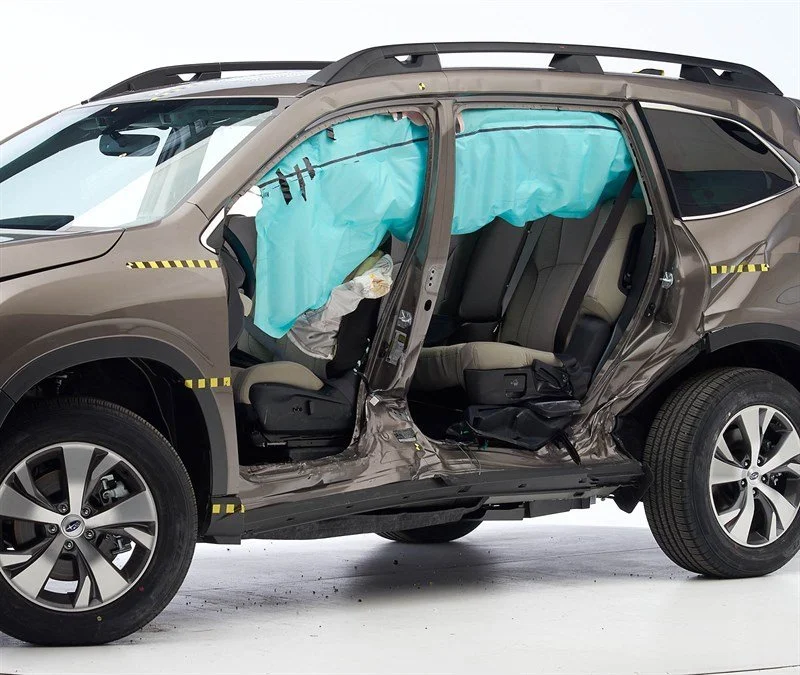
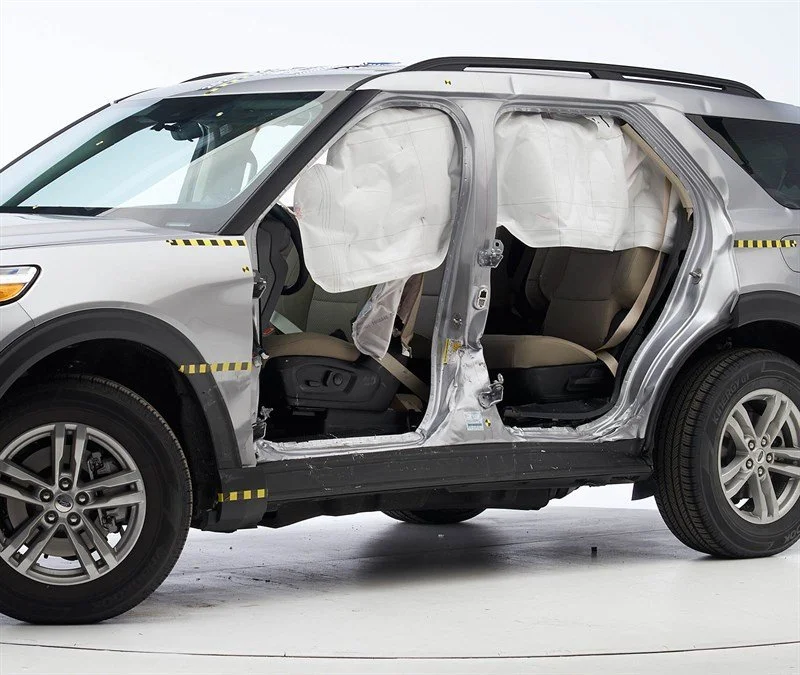
The driver dummy in the Ascent recorded a moderate risk of pelvis injuries. The rear-passenger dummy indicated a low risk of all Injury measures. In all, the Ascent scored the highest rating of Good in this test.
Roof Strength Test
Having a strong roof is crucial during a rollover crash, as it helps to maintain the occupant survival space and reduce the risk of injury or death.
The Ascent withstood just over 21,300 pounds of peak force, which is enough to earn the highest rating of Good.
Automatic Emergency Braking
Let's examine the technologies that can help avoid collisions.
An Automatic Emergency Braking system uses cameras or sensors to detect an imminent collision and autonomously applies the brakes.
The Ascent was tested in its abilities to avoid collisions with pedestrians in both day and night conditions at speeds up to 37 miles per hour. We can assume that if the vehicle stops for pedestrians, it will also stop for vehicles which are larger and easier for the system to detect.
During the daytime test, the vehicle performed flawlessly and autonomously stopped in all conditions.
The Ascent had mixed results in the night time pedestrian avoidance test. When using high beams, the vehicle autonomously came to a complete stop in all scenarios. However, when using low beams, the vehicle failed to stop when encountering a parallel pedestrian.
Headlights
Let's now evaluate the performance of the headlights, as they play a crucial role in reducing the extra hazards that driving at night can pose.
The Ascent’s low and high beams performed well in almost all situations. The low beams fell a little short on the left side of the straightaway, but this is partially mitigated by high beams that automatically turn on. The Ascent earns the highest rating of Good in this test.
Conclusion and Recommendation
Overall, the Ascent did well and is one of the safest choices among midsize SUVs. There is some room for improvement to this Subaru’s structural strength in the updated side-impact evaluation. Also, the performance of the night time automatic braking when using the low beams is insufficient. The Ascent did well in the other tests, and all things considered, makes an excellent choice.